Money and banks
A bank with 1,000 of deposits and a 10 percent reserve ratio can pay only 100 at once, yet it works because few people ask on the same day. The reserve ratio is the share of deposits a bank keeps ready to pay out. From that one fact this course builds money, bank balance sheets, the money multiplier, central banks, deposit insurance, bank runs and digital payments, with worked numbers you can check yourself.
About this course
A bank with 1,000 of deposits and a 10 percent reserve ratio can pay only 100 at once. It still works because few people ask for their money on the same day. This course starts from that fact and builds money, bank balance sheets, the money multiplier, central banks, deposit insurance, bank runs and digital payments, all with numbers you can check yourself.
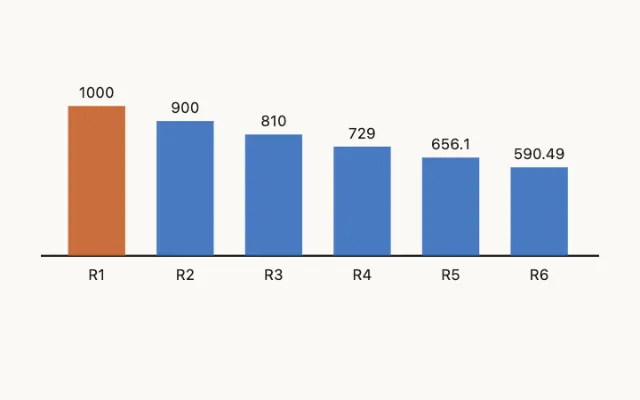
The first unit shows why barter fails: 10 goods need 10 × 9 ÷ 2 = 45 exchange rates, but with money they need only 9 prices. The history unit runs from the first coins in Lydia around the 7th century BC to 15 August 1971, when the United States stopped exchanging dollars for gold at $35 an ounce. The banking unit follows Maple Bank, with reserves of 100, securities of 200, loans of 700 and deposits of 900. It earns a profit of 14 on net worth of 100, but if 15 percent of its loans default, its net worth turns negative at −5. The multiplier unit follows a deposit of 1,000 through rounds of 900, 810 and 729 toward 10,000. The central bank unit compares the Federal Reserve, created on 23 December 1913, with the Bank of Korea, set up on 12 June 1950. The run unit covers the roughly $42 billion that customers tried to withdraw from Silicon Valley Bank on 9 March 2023. The last unit covers cards, stablecoins and central bank digital currencies.
In 1945 the economist R. A. Radford described a prisoner-of-war camp where the prisoners received the same Red Cross rations but wanted different things. Nobody planned a currency, yet cigarettes became one, and even non-smokers accepted them because they knew others would.
Before you start
No finance background is needed. Percentages and simple multiplication are enough, as in Decimals and percent, and the idea of prices from Supply and demand helps a little. The bank examples use invented numbers, so a pencil and a calculator are all you need to check them.
When you finish
You can explain why 10 goods need 45 exchange rates under barter, read a bank's balance sheet and tell whether it is solvent. You can follow a deposit through the banking system and compute the money multiplier as 1 divided by the reserve ratio. You can describe what the Federal Reserve and the Bank of Korea do, how a bank run and deposit insurance work, and how cards, crypto and digital central bank money differ. The course is general education, not advice on where to keep money.
- 1What money isA baker who wants cloth must find a tailor who wants bread. Money removes that search: anything that everyone will accept in payment lets the baker sell to one person and buy from another.
- 2A short history of moneyOn 15 August 1971 the United States stopped exchanging dollars for gold at $35 an ounce. Since then no major currency has been tied to a metal.
- 3What banks doA bank takes in deposits that people want to keep safe and lends part of them to people who want to borrow. The gap between the two interest rates pays for the bank.
- 4Fractional reserves and the money multiplierIf a bank keeps 10 percent of deposits as reserves, a new deposit of 1,000 can end up supporting 10,000 of deposits across the banking system, as the loans keep being re-deposited.
- 5Central banks and their toolsThe Federal Reserve and the Bank of Korea each aim for prices that rise about 2 percent a year, and both steer the economy mainly through one short-term interest rate.
- 6Bank runs and deposit insuranceOn 9 March 2023 customers tried to pull about $42 billion out of Silicon Valley Bank in a single day. Deposit insurance exists to make that kind of day rare.
- 7Digital payments, crypto and CBDCsMost of the money you spend never exists as paper. A payment is a change in two bank balances, and the rest is how the message gets there.
Course map
Economics · Courses: 3
Sources for this course (20)
- OpenStax, Principles of Economics 3e : 14.1 Defining Money by Its Functions, 14.2 Measuring Money: Currency, M1, and M2, 14.3 The Role of Banks, 14.4 How Banks Create Money (openstax.org/books/principles-economics-3e/pages/14-1-defining-money-by-its-functions and the following pages)
- 15.1 The Federal Reserve Banking System and Central Banks, 15.2 Bank Regulation, 15.3 How a Central Bank Executes Monetary Policy (openstax.org/books/principles-economics-3e/pages/15-1-the-federal-reserve-banking-system-and-central-banks and the following pages)
- Board of Governors of the Federal Reserve System: The Fed Explained (federalreserve.gov/aboutthefed.htm)
- Federal Reserve Act of 1913 and structure of the Fed, monetary policy tools and FOMC target range for the federal funds rate (federalreserve.gov/monetarypolicy.htm)
- reserve requirement ratios set to zero effective 26 March 2020 (federalreserve.gov/monetarypolicy/reservereq.htm)
- Review of the Federal Reserve's Supervision and Regulation of Silicon Valley Bank, April 2023 (federalreserve.gov)
- Bank of England, Money creation in the modern economy, Quarterly Bulletin 2014 Q1 (bankofengland.co.uk)
- FDIC: Deposit Insurance (fdic.gov/resources/deposit-insurance)
- History of the FDIC and the Banking Act of 1933 (fdic.gov/about/history)
- Silicon Valley Bank and Signature Bank failures, March 2023 (fdic.gov)
- U.S. Department of the Treasury and Federal Reserve History: Gold Reserve Act of 1934, Bretton Woods 1944, the end of dollar convertibility on 15 August 1971 (federalreservehistory.org)
- Encyclopaedia Britannica: money, coin (Lydia)
- paper money (Song dynasty)
- gold standard. 한국은행: 한국은행 소개와 연혁(1950년 6월 12일 설립)
- 금융통화위원회와 기준금리, 물가안정목표(bok.or.kr)
- 우리나라 화폐의 역사(한국은행 화폐박물관)
- 예금보험공사: 예금자보호제도, 보호한도(kdic.or.kr)
- R. A. Radford, The Economic Organisation of a P.O.W. Camp, Economica 12 (1945)
- Bitcoin white paper, S. Nakamoto, 31 October 2008. 가상자산 이용자 보호 등에 관한 법률(2024년 7월 19일 시행, 법제처 law.go.kr)
- All worked numbers on reserves, T-accounts and the money multiplier are invented for teaching and were recomputed.
Checked: 2026-10-27